Construction Waste: The Silent Carbon Killer
Home Construction Waste: The Silent Carbon Killer
Home Construction Waste: The Silent Carbon Killer
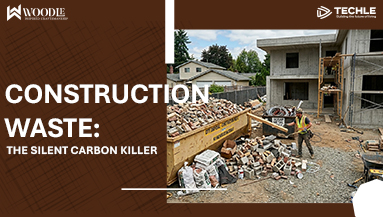
Walk past any construction site, and you’ll see progress: walls rising, materials stacked, the unmistakable promise of something new taking shape. But look closer, and a quieter story is unfolding beneath the surface. Broken bricks. Excess concrete. Unused steel. Discarded wood.
Traditional construction sites waste up to 30% of their materials. That figure alone is staggering, but the true cost runs far deeper than a budget line. Every wasted piece carries a hidden footprint: the energy consumed to manufacture it, the fuel burned to transport it, the natural resources extracted to create it.
When these materials are discarded, none of that effort vanishes. It converts into carbon emissions, landfill overflow, and environmental damage that compounds quietly over decades. Such waste is the cost most people never account for. And it starts long before the first brick is laid.
To comprehend the environmental impact of construction, one must trace back to the very beginning, before the walls, the foundation, and the arrival of the cement mixer on site.
Sand mining is one of the most destructive and least discussed consequences of conventional construction. Concrete, the backbone of traditional buildings, requires enormous quantities of sand. Globally, the construction industry consumes an estimated 50 billion tonnes of sand every year, making it the most extracted solid material on Earth after water.
River beds are stripped bare. Coastlines erode. Marine ecosystems collapse. And for what? This scenario means that a significant portion of the concrete can end up as rubble on a construction site that has run over budget and is behind schedule.
Then there’s cement production. Manufacturing one tonne of cement releases approximately 0.9 tonnes of CO? into the atmosphere. The cement industry alone is responsible for nearly 8% of global carbon emissions, more than the entire aviation sector. Every column poured, every slab cast, and every wall plastered using the traditional method quietly feeds one of the world’s largest industrial carbon sources.
Once you mix, form, and eventually waste these materials on site, you cannot undo that footprint. The carbon is already in the atmosphere. The sand is already gone from the riverbed. This is the upstream construction cost that almost no one talks about.
Now bring it back to the jobsite. In conventional construction, materials are ordered in bulk with buffer quantities built in “just in case.” Cuts are made on-site, generating offcuts that serve no further purpose. Weather damages materials left exposed. Miscalculations lead to over-ordering. Human error leads to rework. And through it all, waste accumulates, silently, steadily, and at scale.
Studies estimate that the global construction industry generates over 2.2 billion tonnes of waste annually. In developing markets, limited oversight and stretched waste management infrastructure result in the majority of waste ending up in landfills or illegal dumps.
The compounding effect is brutal: first, you extract and process far more than you need. Then, you waste a significant portion of what you extracted. And finally, what’s discarded continues to leach toxins, release methane, and occupy land that could serve communities for generations. Construction waste isn’t a side effect. It’s baked into the model.
Safety in construction is rarely talked about in terms of what doesn’t happen: no runaway costs, no surprise rework, no materials degrading in the open air, and no invisible carbon debt accumulating with every pour of concrete. At Techle Indo Innovation, that is precisely where we start.
We didn’t build a greener process to earn a green label. We engineered a fundamentally safer, smarter building system, and zero waste is simply what responsible engineering looks like when done properly.
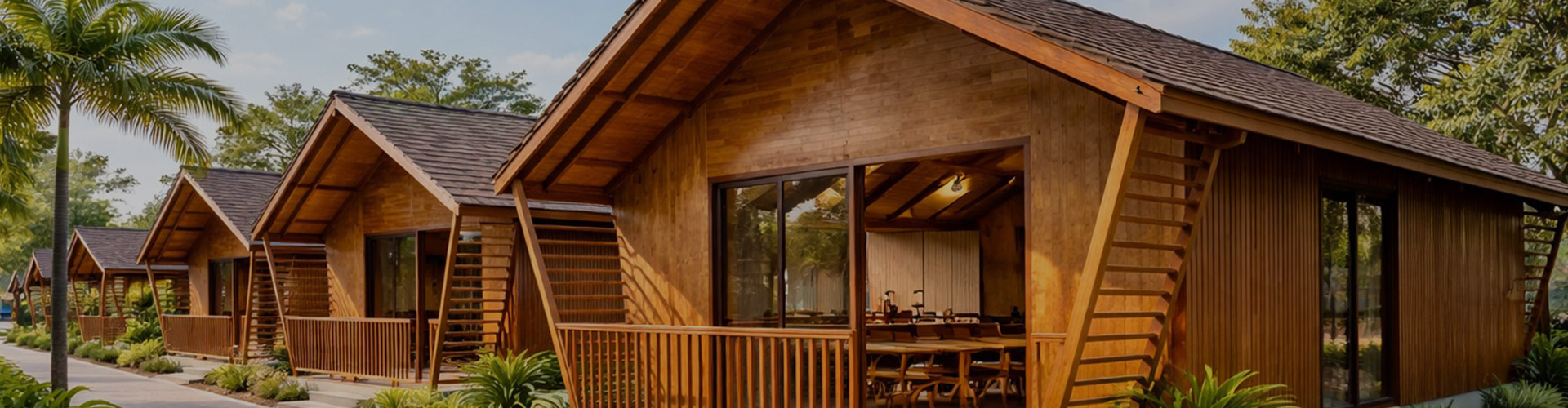
Every Techle home begins not on your plot but inside our precision-controlled manufacturing facility in Jepara, Indonesia, the historic heart of the world’s finest woodworking tradition. Before a single shovel touches your land, your home’s components are designed, engineered, and fabricated under one roof, in a controlled environment where every variable is managed. That is the foundational safety guarantee we offer: certainty before construction begins.
Here is what that means in practice:
If you’re a developer planning a resort, a homeowner designing your dream villa, or an architect working on an eco-sensitive project, the choice of construction method is no longer just a question of cost and speed.
It’s a question of legacy.
A conventional build may appear straightforward on paper. However, when you factor in the material waste, the carbon emissions from cement, the extracted sand, and the energy consumed, the true cost of “cheaper” construction becomes clear.
Techle homes (Aluminum Hybrid-Wooden Home, Woodle Wooden Home, or CLT Home), by contrast, arrive at your site as a near-complete system. Precision-manufactured. Rigorously tested. It is designed to minimize waste from the start, not just clean it up later.
The construction industry accounts for nearly 39% of global carbon emissions when both the building process and the energy used to operate buildings over time are included. Changing that number requires changing the model, not incrementally but fundamentally.
Factory-first construction is a fundamental shift.
It replaces guesswork with precision. It replaces extraction with engineering. It replaces the 30% waste model with a design philosophy where every material has a purpose, every component has a place, and nothing is treated as expendable.
At Techle, we call this “building with a conscience.” It’s not just a catchy phrase; it’s the only way to describe a process that truly eliminates waste.
Explore how knock-down home technology can transform your next project. Contact our home installation experts to build faster, cleaner, and smarter.